HDPE vs PP Sheet: Which Material Is Better for Chemical and Water Treatment Equipment?
When selecting plastic sheet materials for chemical processing equipment and water treatment systems, buyers often compare HDPE sheet and PP sheet. Both materials are widely used in industrial fabrication because they offer good chemical resistance, low moisture absorption and reliable machinability. However, they are not interchangeable in every project.
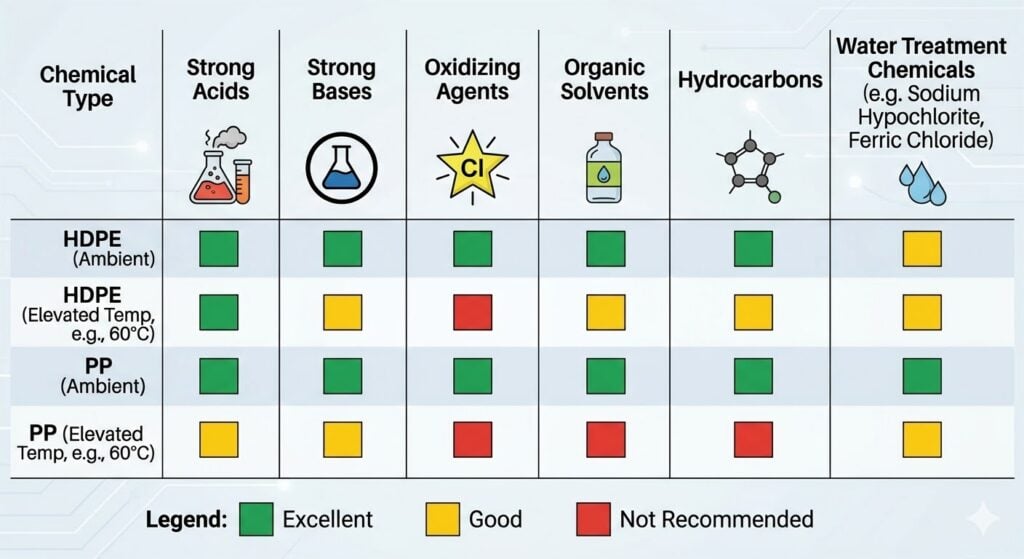
The better choice depends on the actual operating environment, including chemical exposure, working temperature, mechanical load, fabrication method and service life requirements. In many general-purpose water treatment and corrosion-resistant applications, HDPE sheet is valued for its impact resistance and cost efficiency. In more demanding chemical environments or higher-temperature fabrication projects, PP sheet is often preferred for its rigidity and improved heat resistance.
This article explains the main differences between HDPE sheet vs PP sheet and helps industrial buyers choose the right material for tanks, scrubbers, piping support structures, lining parts and custom fabricated equipment.
| Feature | HDPE (High-Density Polyethylene) | PP (Polypropylene) |
| Chemical Resistance | Excellent; best for strong acids/bases, and some oxidants. | Excellent; best for organic solvents and certain acids at high temperatures. |
| Water Absorption | Exceptionally low ($<0.01\%$). Immersible. | Very low ($<0.03\%$). Immersible. |
| Max Service Temperature | $\sim82^\circ\text{C}$ ($180^\circ\text{F}$); can soften sooner under load. | $\sim100^\circ\text{C}$+ ($212^\circ\text{F}$+); retains stiffness at higher temps. |
| Low Temp. Performance | Exceptional; remains ductile down to $-100^\circ\text{C}$ ($-148^\circ\text{F}$). | Becomes brittle near freezing ($0^\circ\text{C}$ / $32^\circ\text{F}$). |
| Impact Strength | Very High; extremely durable and resistant to cracking. | Good, but lower than HDPE; can be notched or crack on high impact. |
| Stiffness / Rigidity | Moderate; more flexible than PP. | High; stiffer and retains shape better under load. |
| UV Resistance | Poor (requires black or UV-stabilized grades for outdoors). | Poor (requires UV stabilization for outdoors). |
| Fabrication | Excellent weldability (butt, extrusion, hot gas). | Excellent weldability; often considered easier to weld than HDPE. |
| Typical Cost | Often slightly less expensive than PP. | Often slightly more expensive than HDPE. |
1. What Is HDPE Sheet?
HDPE sheet is a thermoplastic sheet made from high-density polyethylene. It is known for strong impact strength, low water absorption, good chemical resistance and easy fabrication. HDPE is commonly used in:
- water treatment tank covers
- liner panels
- ground and wet-area protective parts
- general chemical containment components
- machined industrial plastic parts
For projects where moisture, corrosion and outdoor exposure are important concerns, HDPE plastic sheet is often a practical and economical option.
2. What Is PP Sheet?
PP sheet is a thermoplastic sheet made from polypropylene. Compared with HDPE, it generally offers better rigidity, improved heat resistance and stable performance in many corrosive industrial environments. PP sheet is widely used in:
- chemical tanks
- pickling and plating equipment
- fume scrubbers
- water treatment structures
- fabricated industrial vessels
- process equipment housings
For equipment that requires stronger dimensional stability and better performance at elevated temperatures, PP sheet is often the more suitable choice.
3. HDPE vs PP Sheet: Key Differences
3.1 Chemical Resistance
Both HDPE sheet and PP sheet perform well in many corrosive environments, which is why both are common in chemical equipment fabrication and water treatment systems.
- HDPE sheet performs well against many acids, alkalis and moisture-heavy environments.
- PP sheet is also highly resistant to a wide range of chemicals and is often selected for more demanding chemical process equipment.
For many mild to moderate chemical applications, either material may work. But when the system involves more aggressive process conditions, longer operating cycles or stricter fabrication standards, buyers often move toward PP sheet.
3.2 Temperature Resistance
One of the biggest differences in HDPE vs PP sheet is temperature performance.
- HDPE sheet is suitable for many general industrial environments, but its heat resistance is relatively lower.
- PP sheet typically performs better in higher-temperature operating conditions.
Because of this, PP sheet is commonly chosen for chemical tanks, process equipment and water treatment units that may face warmer liquids, heated chemicals or fabrication environments where better thermal stability is needed.
3.3 Rigidity and Structural Stability
- HDPE sheet is tougher and more impact-resistant, with a slightly softer feel.
- PP sheet is usually more rigid and dimensionally stable.
If your equipment requires flatter panels, stronger shape retention or more structural stiffness, PP sheet may be the better fit. If the project values toughness and impact absorption, HDPE sheet can be advantageous.
3.4 Impact Resistance
HDPE sheet is generally known for stronger impact resistance, especially in handling, transportation and applications where physical abuse may occur.
This makes HDPE useful for:
- protective panels
- covers
- machine guards
- outdoor and wet-area boards
- general-purpose fabricated parts
For applications where the material may be knocked, bent or exposed to rough service conditions, HDPE sheet is often preferred.
3.5 Fabrication Performance
Both materials can be processed into industrial components, but their behavior in fabrication can differ depending on the method used.
Common fabrication methods include:
- cutting
- welding
- bending
- routing
- CNC machining
- custom part fabrication
PP sheet is widely used in professional tank and equipment fabrication because of its rigidity and suitability for many chemical process structures. HDPE sheet is also easy to machine and fabricate, especially for wear parts, covers and general custom plastic components.
3.6 Cost Consideration
For many buyers, cost is an important factor in the HDPE vs PP sheet decision.
- HDPE sheet is often selected where cost efficiency and general corrosion resistance are priorities.
- PP sheet may offer better value in higher-spec industrial systems where heat resistance, rigidity and longer-term process suitability matter more than initial sheet price alone.
The right material is not simply the cheaper one. It is the one that best matches the operating conditions and reduces later replacement or fabrication issues.
4. Which Material Is Better for Chemical Equipment?
For chemical equipment, PP sheet is often the better choice when the application involves:
- higher operating temperatures
- stronger dimensional stability requirements
- fabricated tanks and vessels
- corrosive process structures
- industrial chemical contact systems
Typical applications include:
- chemical storage tanks
- scrubbers
- process vessel panels
- plating equipment
- corrosion-resistant fabricated housings
However, HDPE sheet is still widely used for less demanding chemical-related components, especially where impact resistance, moisture resistance and cost control are important.
5. Which Material Is Better for Water Treatment Equipment?
For water treatment equipment, both materials are widely used, but the selection depends on the equipment type.
HDPE sheet is often suitable for:
- tank covers
- liner sheets
- protective panels
- outdoor water-related equipment
- moisture-exposed support parts
PP sheet is often suitable for:
- chemical dosing tanks
- corrosion-resistant structural panels
- fume and chemical handling units
- fabricated process equipment
- higher-temperature treatment systems
If the system is mainly exposed to water, humidity and moderate chemicals, HDPE sheet may be a very practical solution. If the water treatment line includes stronger chemical media, stricter fabrication requirements or elevated process temperatures, PP sheet is often the better engineering choice.
6. How Industrial Buyers Should Choose
Before requesting a quotation, buyers should clarify the following points:
- What chemicals will contact the sheet?
- What is the operating temperature?
- Is the project for tank fabrication, lining, machined parts or support panels?
- Does the equipment require stronger rigidity or stronger impact resistance?
- Will the parts be used indoors or outdoors?
- What thickness, sheet size and quantity are required?
- Is welding, bending or CNC machining needed?
If these details are provided in advance, the supplier can recommend whether HDPE sheet or PP sheet is more suitable for the project.
7. HDPE vs PP Sheet: Quick Selection Guide
Choose HDPE sheet when you need:
- good general chemical resistance
- strong impact resistance
- good moisture resistance
- economical material selection
- general-purpose water-related industrial parts
Choose PP sheet when you need:
- better heat resistance
- stronger rigidity
- improved dimensional stability
- more suitable material for chemical tank fabrication
- better performance in more demanding process environments
There is no single answer to the HDPE vs PP sheet question for all industrial projects. For general water treatment, protective structures and cost-sensitive corrosion-resistant parts, HDPE sheet is often a strong option. For chemical equipment, fabricated tanks and systems with higher temperature or rigidity requirements, PP sheet is frequently the better material.
The correct choice should always be based on your actual application, fabrication method and operating conditions.
If you are sourcing HDPE sheet or PP sheet for chemical equipment or water treatment projects, send your required thickness, sheet size, quantity, application and drawing. Our factory can help recommend the suitable material and provide a direct quotation for standard sheets or custom fabricated parts.
FAQ
1. Is HDPE or PP better for chemical tanks?
For many chemical tank fabrication projects, PP sheet is often preferred because it offers better rigidity and better heat resistance. HDPE sheet can still be used for some less demanding chemical containment applications.
2. Is HDPE sheet suitable for water treatment equipment?
Yes. HDPE sheet is widely used in water treatment equipment for covers, liners, moisture-resistant panels and general corrosion-resistant parts.
3. Why is PP sheet often used in industrial fabrication?
PP sheet is commonly selected for industrial fabrication because of its good chemical resistance, stronger rigidity and better suitability for fabricated process equipment.
4. Which material has better impact resistance, HDPE or PP?
In general, HDPE sheet offers better impact resistance, which makes it useful for protective and general-purpose industrial applications.
5. Which material handles higher temperatures better?
PP sheet usually performs better than HDPE sheet in higher-temperature applications.
6. Can both HDPE and PP sheets be welded?
Yes. Both HDPE sheet and PP sheet can be fabricated by welding, cutting and machining, depending on the project design and processing requirements.
7. Is HDPE cheaper than PP sheet?
In many cases, HDPE sheet is chosen as a more cost-efficient option for general industrial use, but the final decision should consider performance requirements rather than sheet price alone.
8. Which sheet is better for chemical dosing systems?
For many chemical dosing and more demanding process systems, PP sheet is often the more suitable choice because of its rigidity and heat resistance.
9. What information should I provide before asking for a quotation?
You should provide:
- material preference if known
- application
- sheet thickness
- sheet size
- quantity
- chemical medium
- operating temperature
- drawing or processing requirements
Can you supply custom-cut or machined HDPE and PP sheets?
Yes. Custom services can include sheet cutting, CNC machining, fabrication based on drawings and bulk supply for industrial projects.