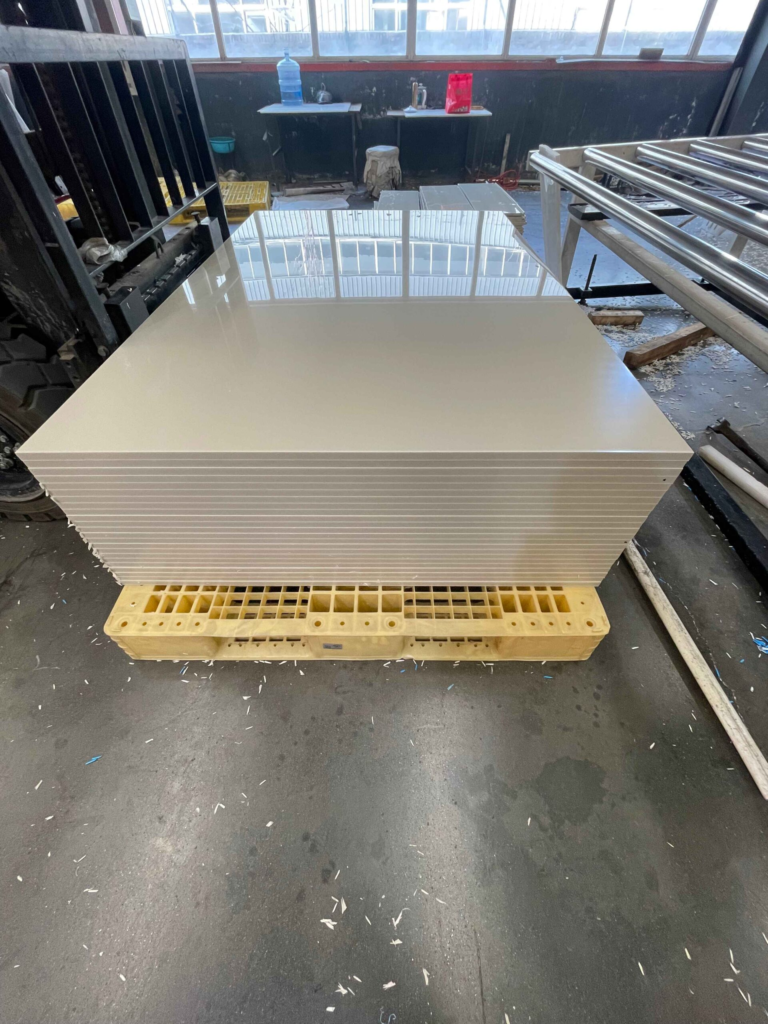
6 mm UHMWPE sheet is a thin wear-sheet option for backed liners, sliding surfaces and guide strips. Where space is limited, this thickness may suit a replaceable wear layer; it should not be treated as a rigid structural panel spanning an unsupported opening.
UHMWPE is ultra-high molecular weight polyethylene, also called PE-UHMW or PE 1000 in engineering-plastics catalogues. It is not interchangeable with standard HDPE. Thickness describes the sheet geometry, not its material grade. Our UHMW-PE mechanical data and wear-part selection guide explains the grade-specific properties to compare.
- Abrasive wear: evaluate the conveyed material, particle size and contact surface. Molecular weight alone does not predict the wear life of a finished liner.
- Impact and support: UHMWPE is valued for impact resistance, but a 6 mm sheet still needs suitable backing and fastening where material strikes the liner.
- Sliding friction: low friction makes UHMWPE useful for guides and wear strips. Contact pressure, speed and the opposing surface determine whether the assembly can run dry.
- Dimensional movement: low water absorption is useful in wet service, but thermal expansion and deformation under sustained load still affect clearances and fixing details.
- Chemical exposure: check the actual chemical or cleaning agent, concentration, temperature and exposure time against data for the offered grade, especially for oxidizing chemicals.
- Food contact: conveyor guides and handling surfaces that contact food require a suitable grade and documentation for the intended use and destination market. An industrial UHMWPE sheet is not automatically food-contact compliant.
- Material flow: a low-adhesion surface can help reduce buildup, but hopper geometry, moisture and the conveyed material also determine whether a liner improves discharge.
- Temperature: specify normal and peak temperatures together with the load and exposure duration. Low-temperature toughness is grade-dependent; this sheet listing is not an approval for cryogenic service.
Where a 6 mm Wear Sheet Can Be Considered
- Chute and hopper liners: consider a backed, replaceable lining where the wear allowance and impact conditions suit 6 mm. Plan joints and fasteners so the sheet can expand without buckling.
- Conveyor and packaging guides: flat wear strips, side guides and sliding pads can be cut from sheet when the drawing suits the thickness. Rollers, star wheels and bushings may require thicker blanks, rods or tubes rather than a 6 mm sheet.
- Paper-machine wear parts: guides and wear strips are possible UHMWPE applications. Suction-box covers, doctor blades and dewatering foils need the machine maker's profile, material grade and support requirements; they are not generic 6 mm sheet uses.
- Chemical-handling liners: assess chemical compatibility alongside the mechanical duty. Pump, seal and bearing components need their own drawing and operating specification, not only a sheet-material name.
- Outdoor or cold-service guides: identify sunlight exposure, minimum temperature and fixing conditions. Confirm the appropriate UV-stabilized or low-temperature grade rather than assuming every UHMWPE sheet has those capabilities.
Sheet Formats and 6 mm Availability
Our listed sheet formats cover both thin sheet and thicker board. Only the 3050 × 1220 mm format below has a stated thickness range that includes 6 mm. Confirm the offered format, grade and current availability before ordering; the other listed ranges start at 10 mm.
- 3000 × 1500 mm — listed thickness range: 10–300 mm
- 4700 × 1200 mm — listed thickness range: 10–300 mm
- 5000 × 1300 mm — listed thickness range: 10–300 mm
- 4500 × 2000 mm — listed thickness range: 10–300 mm
- 3050 × 1220 mm — listed thickness range: 6–100 mm
For cut liners or guides, send a drawing showing finished dimensions, hole positions, edge details and the backing surface. Include required thickness tolerance and flatness. We review whether the proposed sheet and machining arrangement can meet those requirements before confirming supply.
Specify the Liner and Its Installation
- Fit and fastening: identify the wear face, joints, fixing method and expansion allowance. Recessed fasteners must leave enough material around the holes and below the wear surface.
- Inspection: agree the grade identification, dimensional tolerances, surface condition and any material-document requirements for the order.
- Export packing: specify full sheets or cut parts, quantity and delivery destination so we can confirm sheet protection, pallet or crate dimensions and shipment arrangements.
Enquire About 6 mm UHMWPE Sheet
Send us your liner or guide drawing with the required grade, sheet size or cut dimensions, quantity and delivery destination. Describe the contact material, support and operating conditions so we can review the 6 mm configuration and quote the agreed supply scope.