Plan an HDPE ground protection mat order around the route, ground and traffic it must serve. Mat dimensions and surface pattern are only part of the decision: vehicle contact loads, turns, connections, handling and changing ground conditions determine what needs checking before use.
Use the checklist below to prepare a request for quotation (RFQ) for construction, utility, industrial, event or rental projects. It is a purchasing guide, not approval of a temporary road or a universal load rating. The responsible site team must assess the installed system for the intended traffic.
Before requesting a quotation: send details of each vehicle in its loaded operating condition, including axle or track loads and tyre or track contact data. Identify the heaviest vehicle and any concentrated loads. Add expected traffic, soil and moisture conditions, route dimensions, slopes, turning areas and installation constraints.
The mat and ground must work together
HDPE ground protection mats are temporary panels for supported vehicle or pedestrian routes. They can help spread contact loads and limit surface damage when the mat construction, layout and supporting ground suit the traffic. Assess the complete installed route, not just the sheet material.
A mat alone does not make an unstable subgrade suitable for traffic. Ordinary ground protection mats are not trench or void bridges. Soft spots, standing water, steep slopes, tight turns, braking and concentrated equipment loads require a separate site assessment. A ground protection mat is not automatically a crane outrigger pad.

1. Describe the ground before selecting mats
Describe the soil, drainage, recent rain, vegetation, ruts, soft areas, stones and debris. Mark known buried services or voids. Route photos and a short video help explain the conditions, but they do not replace a qualified site or geotechnical assessment where the risk requires one.
The responsible site team should decide whether grading, drainage, geotextile or another preparation measure is needed. Firm, even support helps limit rocking and local bending. A result obtained on dry, compacted ground cannot establish suitability over saturated mud or a hidden void.
2. Provide vehicle loads and traffic details
Total vehicle mass alone does not define the loading on a mat. Axle loads, wheel or track contact area, tyre pressure, repeated passes, speed, braking, turning and attachments all matter. Crane outriggers and stabiliser legs impose concentrated loads and need a separately engineered support arrangement.
| Vehicle loading input | Data to provide | Why it matters |
|---|---|---|
| Vehicle configuration | Vehicle model, wheel or track type, axle spacing and attachments | Shows where contact loads act and how they move along the route |
| Maximum operating mass | The fully loaded operating condition, not the empty shipping weight | Identifies the highest expected vehicle mass |
| Tyre and track contact | Tyre size and pressure, or track dimensions and contact pressure where available | Helps assess the contact area, local pressure and surface requirements |
| Traffic movements | Passes per day, travel direction, speed, turning areas and braking zones | Repeated and dynamic loading can govern the mat system's performance |
| Concentrated and special loads | Outriggers, stabilisers, lifted loads, trailers and their contact loads | May need purpose-designed pads or a separate support system |
3. Draw the complete temporary route
Provide the route length and width, entrances, exits, passing points, work areas, staging areas, bends, slopes and transitions to hard surfaces. Mark where vehicles will stop, turn, reverse or load. These areas may need a wider layout or different support from a straight, one-way route.
Include pedestrian crossings, interfaces with public areas, overhead restrictions, drainage paths and mat storage. A scaled drawing helps us identify the proposed panel layout and connector quantities; a total area in square metres does not show how the route fits together.
4. Match surface traction to the traffic and site
Choose the surface pattern for the tyres, tracks or footwear, expected contamination and cleaning method. An aggressive pattern may provide grip in some conditions but can collect debris, be uncomfortable for pedestrians or behave differently under narrow wheels. Confirm which face is intended for each use and whether the quoted mat is reversible.
A textured surface does not remove the risk of slipping. Mud, oil, ice, algae, loose debris, excessive slope, speed and abrupt steering can reduce grip. The site plan should define speed limits, traffic rules, inspection intervals and the conditions for closing the route when weather or ground conditions change.
5. Specify the connections with the layout
Connections can help maintain mat alignment and limit gaps. Their type and arrangement must suit the route width, vehicle movements, turns, slope and installation sequence. Review the layout before specifying two-way, four-way or other connectors; the name alone does not establish suitability.
Confirm connector material, quantities, installation tools, access and spare parts. Retightening or replacement criteria must follow the specified connection system. Damaged holes, missing connectors, edge movement or large gaps need prompt review under the site plan.
6. Request evidence for the quoted mat
| Mat specification | Evidence to request |
|---|---|
| Material and formulation | Which material grade or product code is quoted, and how is any specified recycled content controlled? |
| Dimensions and handling mass | What are the nominal dimensions, tolerances and actual mass of each mat? |
| Surface, colour and marking | What pattern, face orientation and colour are offered? What UV formulation or logo option applies to the quoted mat? |
| Mat connection system | Which connectors match the proposed layout, and are their quantities and spare parts included in the quotation? |
| Performance evidence | Which test method, mat configuration and support conditions apply to a stated performance value? |
| Batch identification | How will the production batch, mat markings and agreed inspection records be linked? |
A figure described as “tonnes per mat” needs its test basis. Confirm whether it describes vehicle mass, axle load, a static or uniformly distributed load, or a laboratory result, and what support or span was used. These figures are not interchangeable and do not, by themselves, establish site suitability.
7. Plan handling, installation and inspection
Define unloading, carrying or mechanical handling, placement, connection, inspection, cleaning and stacking before delivery. Use the handling method and lifting features specified for the supplied mats. Assess mat mass, team size, pinch points, uneven ground, wind, traffic separation and manual-handling limits.
The site-approved installation and recovery plan should cover:
- route preparation and clearly marked exclusion zones;
- a laying sequence that starts from stable ground and suits the site;
- the specified mat orientation and connector arrangement;
- vehicle speed limits and steering rules;
- an initial inspection after the first vehicle passes;
- routine checks for movement, gaps, damage, contamination and soft ground;
- recovery, cleaning, separation of damaged mats and storage.
Use these items with the supplied product instructions, the site risk assessment and applicable local safety requirements. They are not a complete installation method.
8. Check samples, packing and container loading
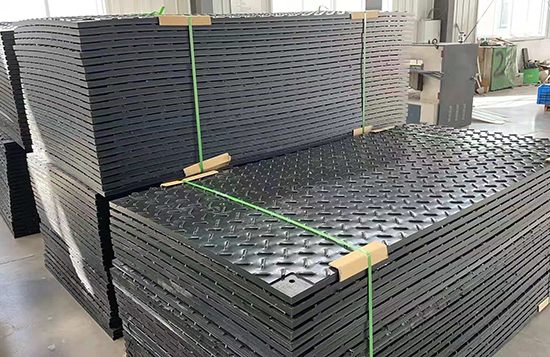
Agree a representative sample for dimensions, surface, colour, handholds or lifting features, connector fit, marking and appearance before a bulk order. The sample helps confirm manufactured features; it does not demonstrate the load capacity of the installed route.
Request a packing layout showing mats and connectors per pallet, pallet dimensions, gross weight, straps, edge protection, labels, stacking limits and fork access. Container quantities need a documented loading plan. Confirm that the receiving equipment can handle the actual pallet size and mass.
Information for an HDPE ground protection mat quotation
| Enquiry section | Project details to provide |
|---|---|
| Ground conditions | Ground type, moisture, slope, drainage, route photos, soft areas and known buried hazards |
| Vehicle loads | Vehicle models, loaded masses, axles or tracks, tyres, attachments and special loads |
| Traffic and duration | Passes, speed, turns, braking, period of use and expected weather conditions |
| Route layout | Scaled route drawing, width, bends, passing and staging areas, and surface transitions |
| Mat configuration | Required dimensions, surface, colour, connectors, logo or marking and quantity |
| Inspection documents | Sample requirements, dimensional report, material grade declaration, batch markings and packing photos |
| Packing and delivery | Destination, requested Incoterms rule, required arrival date, pallet limits and unloading method |
Our ground protection mat buying guide covers product selection. You can also view our HDPE ground protection mats before specifying the dimensions and surface.
HDPE ground protection mat questions
What load can an HDPE road mat support?
No single rating applies to every HDPE mat and route. Review the quoted mat construction, thickness and material grade, ground support, wheel or track contact, traffic, speed, turns and connections. Ask which test conditions support the stated value and have the intended route assessed separately.
Can ground protection mats be laid directly on mud?
Only after the ground and route have been assessed. Very soft, saturated, uneven or voided ground may require drainage, grading, geotextile, aggregate or a different engineered access system. Ordinary ground protection mats are not a substitute for resolving those conditions.
Does a textured mat make a sloped route safe?
No surface pattern makes a sloped route safe on its own. The assessment must consider gradient, vehicle, contamination, braking, weather, route geometry and any required restraint or anchoring. If those conditions cannot be managed with the proposed system, use another access method.
When can ground protection mats be reused?
Reuse depends on the condition of the mat, its connections and the next project's requirements. Clean and inspect the mats, set damaged units aside and follow the agreed handling and storage instructions. Keep inspection criteria and records so that acceptance for another deployment is traceable.
Send your ground protection mat enquiry
Send us the ground conditions, vehicle loads, route drawing, mat requirements, quantity and destination. We will confirm the offered panel, connection and packing scope in the quotation. Supply confirmation is separate from the responsible site team's approval of the installed route.