HDPE vs PP Sheet: Which Material Is Better for Chemical and Water Treatment Equipment?
HDPE and polypropylene (PP) are both used in chemical and water-treatment equipment, but they are not interchangeable. The right choice depends on the exact chemical, concentration, continuous and cleaning temperatures, contact time, mechanical load, welding design and outdoor exposure.
This guide focuses on equipment components—not a generic material ranking. For a broader overview, see our HDPE vs PP sheet comparison.
Start with the process conditions
Material selection should begin with the service environment. A sheet that is suitable for ambient-temperature process water may not be suitable for concentrated chemicals, hot cleaning cycles or a continuously loaded tank wall. Ask these questions before choosing a resin or requesting a quotation:
- Which chemical or water stream contacts the part?
- What are the concentration, normal temperature and maximum cleaning temperature?
- Is contact continuous, intermittent or splash-only?
- Will the part carry liquid pressure, equipment weight or another structural load?
- Will it be welded, thermoformed, machined or mechanically fastened?
- Is it indoors, outdoors or exposed to UV?
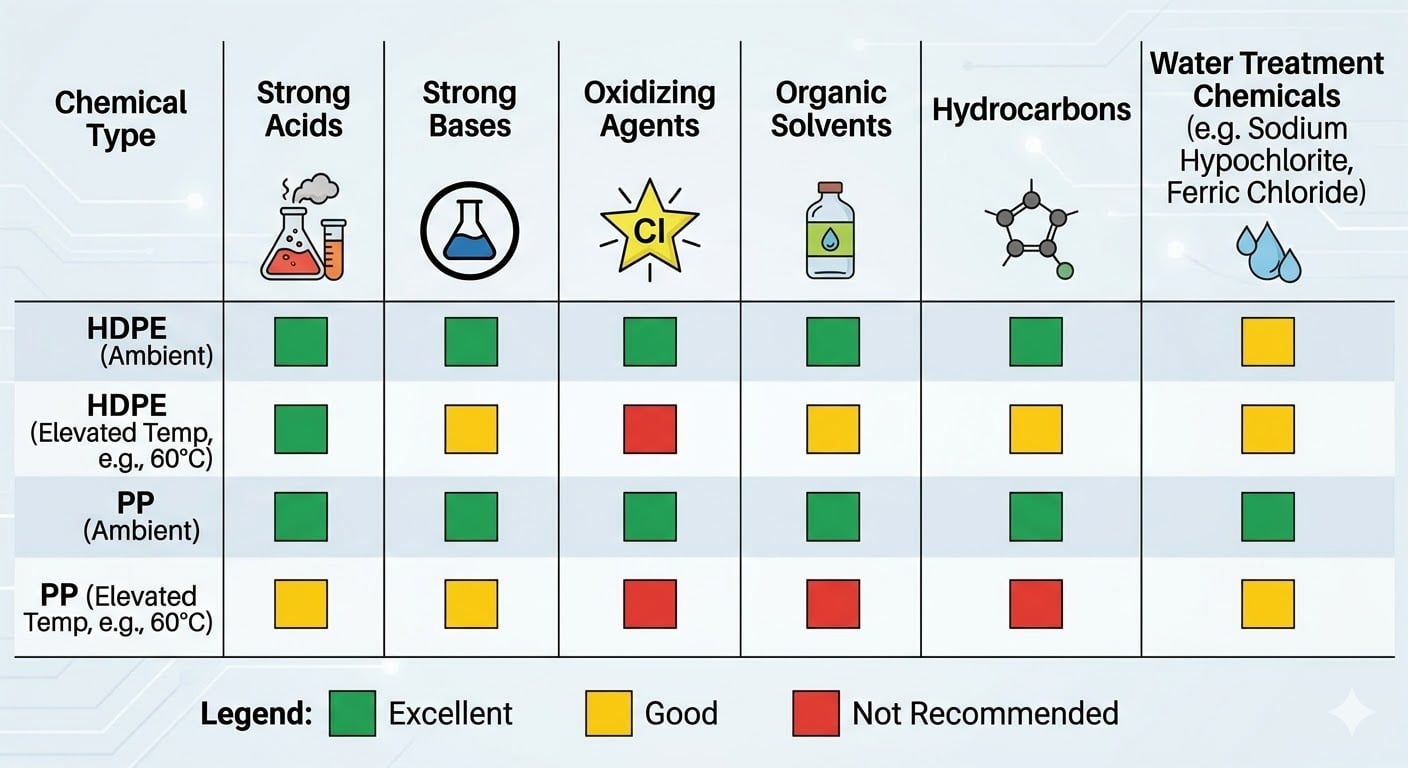
Chemical-resistance charts are only a screening tool. Final suitability must be checked for the specified grade under the combined chemical, temperature, time and stress conditions.
HDPE vs PP by equipment component
| Component or condition | Useful starting point | What must be verified |
|---|---|---|
| Ambient-temperature covers, guards and splash panels | HDPE is often considered where toughness and wet service are priorities | UV grade, span, fastening method and deflection |
| Welded chemical tank or vessel | PP-H or HDPE may be candidates | Chemical compatibility, design temperature, hydrostatic load, weld design and support |
| Scrubber, hood or ventilation component | PP is commonly evaluated for its stiffness and chemical-resistance range | Gas composition, condensate, temperature and fire requirements |
| Baffle, weir or divider in a wet system | Either material may work | Unsupported span, vibration, temperature and fixing points |
| Outdoor or low-temperature component | HDPE may be a useful starting point | UV stabilization, minimum temperature and impact requirement |
| Hot process or hot cleaning cycle | PP-H generally has the higher temperature capability | Grade-specific data, load, exposure duration and thermal expansion |
This table is a shortlisting aid, not an engineering approval. Tank construction and other load-bearing applications require calculations by a qualified designer.
Chemical compatibility comes first
Both materials resist many aqueous chemicals, acids and alkalis, but performance varies with formulation and service conditions. Do not specify “chemical resistant” without naming the medium. Oxidizing chemicals, mixed waste streams, solvents and cleaning agents require particular care because a small change in concentration or temperature can change the recommendation.
For a useful compatibility review, provide the full chemical name, concentration, operating and peak temperatures, exposure duration and whether the part is stressed. If several chemicals are present, include each one and describe the cleaning cycle.
Temperature and structural design
Published manufacturer data commonly shows a higher typical service-temperature range for PP-H than for HDPE. However, the maximum temperature on a data sheet is not automatically the safe design temperature for a tank. Plastics lose stiffness as temperature rises, and continuous stress, liquid head, unsupported span and service life all affect the required thickness and reinforcement.
HDPE is generally more flexible, while PP-H is generally stiffer. That difference affects panel deflection, support spacing and the appearance of a fabricated assembly. Thermal expansion must also be allowed for in long panels, ducting and bolted installations.
Welding and fabrication
HDPE and PP sheets can both be cut, machined and thermoplastically welded. Reliable fabrication requires the correct welding process, matching filler material, controlled parameters, clean joint preparation and trained operators. A good-looking bead alone does not prove joint strength.
When asking us to quote a fabricated component, send the drawing and identify all critical dimensions, weld locations, allowable tolerances and inspection requirements. For sheet-only orders, specify whether the material will be welded at your facility so the sheet and welding rod can be matched.
A practical water-treatment selection method
- Separate the system into components. A cover, tank wall, pipe support and chemical dosing enclosure do not have the same requirements.
- Record the worst credible exposure. Include chemical dosing peaks, cleaning cycles, shutdown conditions and outdoor temperature.
- Screen both materials for chemical compatibility. Use grade-specific data rather than a general statement about “PP” or “HDPE.”
- Check stiffness and loading. Confirm thickness, reinforcement and support spacing with the equipment designer.
- Confirm fabrication and quality controls. Review welding, machining, tolerances and inspection before production.
For chlorine-based, strongly oxidizing or mixed chemical services, do not rely on a rule of thumb. Send the complete process data for a case-by-case review and obtain the required engineering approval.
What to include in your RFQ
| Application | Tank, liner, cover, baffle, scrubber, duct, guard or machined part |
|---|---|
| Process medium | Exact chemical names, concentrations and mixture details |
| Temperature | Normal, peak and cleaning temperatures |
| Contact and load | Continuous/splash contact, liquid head, pressure, span and support |
| Sheet specification | HDPE or PP grade if known, color, thickness, width and length |
| Fabrication | Cutting, CNC machining, bending, welding, holes and tolerances |
| Quantity and delivery | Order quantity, destination, packing needs and required date |
| Documents | Drawing version, inspection items and any certificate requirements |
Zhihong Plastic supplies industrial HDPE sheets, PP-H sheets and FRPP sheets, with cut-to-size and drawing-based processing options. Availability, minimum order and tolerance depend on the requested specification.
Frequently asked questions
Is PP always better than HDPE for a chemical tank?
No. PP may offer advantages in some chemical and higher-temperature conditions, while HDPE may suit other media, temperature ranges and mechanical requirements. The tank design, sheet grade and complete service conditions determine suitability.
Can you recommend a sheet from only a photo?
A photo helps us understand the component, but it is not enough for material approval. We also need the process medium, concentration, temperatures, load, dimensions and fabrication method.
Can you quote from a drawing?
Yes. Send a PDF or CAD drawing with material, thickness, quantity, tolerances and delivery destination. We will review the manufacturability and clarify any missing items before quoting.
Need a material and manufacturing review? Send your process conditions and drawing to request an HDPE or PP sheet quotation.