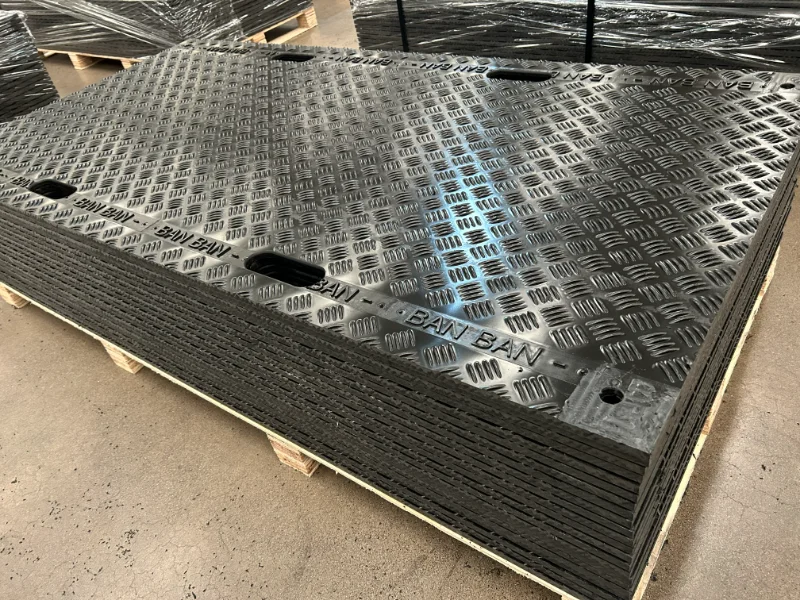
Our HDPE ground protection mats provide a removable running surface for landscaping access, site deliveries and selected event routes. They can help reduce direct wheel or foot contact with grass and soil when the mat, ground conditions and traffic are compatible. Specify temporary roadway mats for vehicles and a suitable walking surface for pedestrians; these are different uses.
Start with the surface beneath the mats, the heaviest axle or wheel load, tyre or track contact area and expected number of passes. Turning, braking, wet ground and long dwell times can change the result. Sheet thickness or gross vehicle weight alone does not establish a safe load rating.
Five checks before choosing a ground protection mat
- Dimensions and handling: confirm panel size, thickness, weight, hand holes and available handling equipment. We confirm the dimensions and configuration offered for each enquiry. A thicker sheet is not a substitute for checking the route and loading.
- Water and ground support: assess drainage, soft spots and existing ruts before laying panels. Mats do not remove water or strengthen unsupported ground; saturated soil may need an engineered access system or ground preparation.
- Load distribution: review tyre or track contact area, axle loads and route width. Panels need support beneath them and a compatible connection layout. Do not use loose mats to bridge ditches or support crane outriggers without a system designed and verified for that purpose.
- Tread and grip: select the upper surface for shoes, tyres or tracks and the underside for grass or paving. Aggressive vehicle tread is not automatically comfortable for pedestrians. Mud, water, wear and displaced joints still need inspection and cleaning; a “non-slip” label is not an accident guarantee.
- Covering time and reuse: plan how long the lawn will be covered and when mats will be removed. Heat, trapped moisture and restricted light can stress turf. Reuse depends on the condition of the panel, tread and connectors, not a promised number of cycles.
Plan the access route around your surface
For lawns, check soil firmness with the groundskeeper or site supervisor and agree the access route before work starts. Avoid sharp stationary turns and repeated traffic outside that route. Inspect both the panels and the surface during use, especially after rain; load spreading does not eliminate compaction or rutting risk.
For paving or finished driveways, remove trapped stones and review the underside, edge transitions and possible panel movement. Natural, synthetic and hybrid sports turf have different requirements. Venue managers should assess the actual flooring system, equipment loads and covering period rather than treating any solid PE sheet as stadium flooring.
Where temporary access mats may be useful
- Landscaping and garden access where an agreed vehicle route needs temporary surface protection.
- Event setup and service routes, with vehicle and pedestrian areas specified separately.
- Temporary walkways across lawns or mixed surfaces, with appropriate tread, joints and edge transitions.
- Construction or utility access over suitable prepared ground; weak soil and sensitive root zones need site-specific assessment.
HDPE ground protection mats are removable access panels, not permanent soil reinforcement, waterproof flooring or unsupported load-bearing platforms. For an event with stages, tents or other concentrated loads, include those load points in the venue’s planning. Environmental benefits depend on actual service life, transport, cleaning and the recovery route for the supplied material, not an “eco-friendly” label.
Mat details to confirm before production
- Mat configuration: required dimensions, thickness, surface pattern, holes, connectors and a drawing where available.
- Evidence: the proposed material and product specification, and any application-specific test information needed to assess the route. We confirm what documentation is available for the offered configuration.
- Logistics: quantity, stacking and lifting constraints, packing dimensions, delivery destination and project schedule.
Request a ground protection mat quotation
Send us your mat requirements and route details, including the surface, vehicle or pedestrian use, wheel or axle loads, quantity and delivery destination. We will review the proposed configuration and confirm available sizes, packing and supply terms before quotation.