HDPE, or high-density polyethylene, is a semi-crystalline member of the polyethylene family. Its combination of low water absorption, impact toughness and chemical resistance makes it useful for industrial sheets and fabricated components. The right choice depends on the grade and operating conditions, not the HDPE name alone.
HDPE properties that matter in sheet applications
HDPE is generally stiffer than LDPE, but stiffness, impact strength and resistance to cracking vary between grades. Density reflects differences in crystalline structure; it is not a complete performance specification. Compare the stated test method and conditions as well as the value.
- Chemical contact: name the chemical or cleaning agent, concentration, temperature, contact time and mechanical load. Resistance to one medium does not establish resistance to a mixture. Swelling or stress cracking can occur without the material dissolving.
- Load and temperature: check stiffness and creep under the actual load and exposure duration. A short-term strength result does not establish long-term dimensional stability.
- Impact: assess the selected grade at the expected temperature, with the part geometry and any notches or holes in mind. Compare HDPE and PP using the actual grades and matched test conditions.
A melting-point result describes a material transition. Melt temperature during processing, heat-deflection temperature under a specified test load, and continuous service temperature answer different questions. Do not use one as a substitute for the others.
Reading melt flow and molecular-weight data
Melt flow rate (MFR), also called melt index (MI) in some supplier literature, measures the mass of polymer passing through a test die in a specified time. Report the temperature, applied load and test method with the value in g/10 min. For HDPE, 190 °C/2.16 kg is a common test condition, but other loads are also used. Values measured under different conditions are not directly comparable. Check how the abbreviation is defined: some documents use MFR for a melt-flow ratio rather than a mass flow rate.
A higher melt flow value generally indicates easier flow within a comparable resin family, not automatically better sheet quality. Melt flow alone does not describe the full molecular-weight distribution (MWD), high-shear processing behaviour or the finished part's impact performance.
Molecular weight and its distribution affect melt behaviour and the balance of processing and end-use properties. Some grades have a bimodal distribution. Use the supplier's grade data and processing guidance rather than assuming that a narrow or broad distribution always produces less warpage or better toughness.
For a specified grade, obtain the relevant density, melt flow, tensile or flexural data and, where required, environmental stress cracking resistance (ESCR). Keep the test conditions and the distinction between typical values and agreed acceptance criteria with the data.
Resin production, sheet manufacture and fabrication
Producing polyethylene resin from ethylene is different from converting that resin into sheet. Resin suppliers control molecular structure and formulation. Sheet producers then select material for the required product and control forming and cooling.
HDPE is supplied in grades intended for extrusion, injection moulding and blow moulding. Sheets may be extruded or pressed, while injection moulding forms material in a closed mould and blow moulding forms hollow articles. A grade suitable for a bottle or thin-wall container is not automatically suitable for a thick sheet or machined component.
For sheet supply, discuss thickness tolerance, flatness, surface finish, colour and any directional behaviour that matters to the finished part. Forming and cooling history can affect crystallinity, residual stress and later dimensional movement.
What injection-moulding guidance can tell a sheet buyer
Injection moulding illustrates why a resin label cannot define a complete process. Filling, packing, cooling and ejection interact with the grade, wall thickness, mould design and machine. Temperature and pressure setpoints from a different part are not a validated recipe for your product.
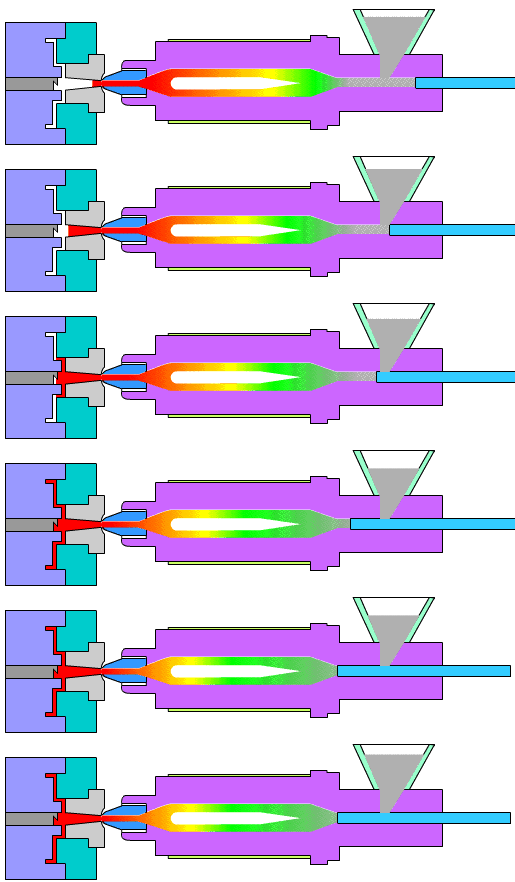
- Incomplete filling (short shot): review resin flow, the flow path, gates and runners, venting and machine settings together. Raising temperature or pressure alone may not solve the cause.
- Flash: excess material at the mould joint requires checks of the mould, clamping and filling or packing conditions.
- Cooling and shrinkage: changing cooling time can change final properties and dimensions. A universal shrinkage percentage or a fixed time to dimensional stability is not appropriate for every grade and geometry.
Follow the resin supplier's processing guidance, applicable safety data sheet and equipment instructions for drying, residence time, shutdown and restart. HDPE is combustible. The appearance or smell of burning plastic is not a safe method of identifying a grade.
Additives, colour and recycled-material requirements
Antioxidants help limit oxidative degradation during processing and use. UV stabilisers and other additives are selected for the formulation and application. Specify outdoor exposure and the supporting grade data; black colour alone does not establish UV protection or service life.
Standard HDPE is electrically insulating, whereas antistatic or conductive formulations have different electrical behaviour. If electrical properties matter, specify the required test and acceptance criteria instead of assuming that every HDPE sheet performs the same way.
Clean in-process regrind and post-consumer recycled material are different feedstocks. Agree any recycled-content requirement, source restrictions and performance checks. Recyclability does not mean that every application permits unrestricted reuse of all scrap.
For food-contact use, identify the intended contact conditions and the documentation required for the actual formulation. The terms HDPE, natural colour or odourless do not by themselves establish suitability.
Cutting, CNC machining and assembly
A machined HDPE part can move as material is removed or its temperature changes. Specify finished dimensions, critical tolerances and the measurement conditions. Discuss machining allowance, flatness and any conditioning requirements before fixing the inspection plan.
Allow for thermal expansion and creep in the assembly, especially around fasteners, long unsupported spans and sustained loads. Hole position, edge distance and mounting clearance should be considered with the drawing rather than treating HDPE like a metal plate.
Printing, bonding or welding requires a process suited to the material and application. For printing or adhesive bonding, review surface preparation and ink or adhesive compatibility. If welded joints are required, identify the grades and joint requirements so the fabrication route and validation can be assessed.
Discussing your HDPE sheet or component
We review HDPE sheet supply, cut-to-size work and CNC machining by request. Send the required thickness, width, length and quantity, or a component drawing with the critical dimensions. Include the chemical exposure, temperature, load, outdoor conditions and any material specification that the part must meet.
Send these details with your HDPE sheet or machined-part enquiry. We confirm the offered material, fabrication scope, inspection requirements, packing, minimum order quantity and lead time in the quotation.
Technical references for interpreting grade data
The Asahi Kasei SUNTEC-HD property table illustrates grade-specific melt flow conditions and typical values. LyondellBasell's HDPE cooling-time study explains how processing can affect final part performance. These are technical references, not specifications or certificates for our sheets.