
Two-color HDPE engraving board uses a surface color over a contrasting core. Routing through the cap layer reveals the core, creating permanent text, symbols or graphics without relying on printed ink. The result depends on cap thickness, tool geometry, engraving depth, artwork, color contrast and mounting—not simply on choosing a “two-color sheet.”
This buyer guide covers material specification, CNC setup questions, artwork, inspection and RFQ details for equipment labels, nameplates and facility signage. Product availability and custom color minimums must be confirmed in the quotation.
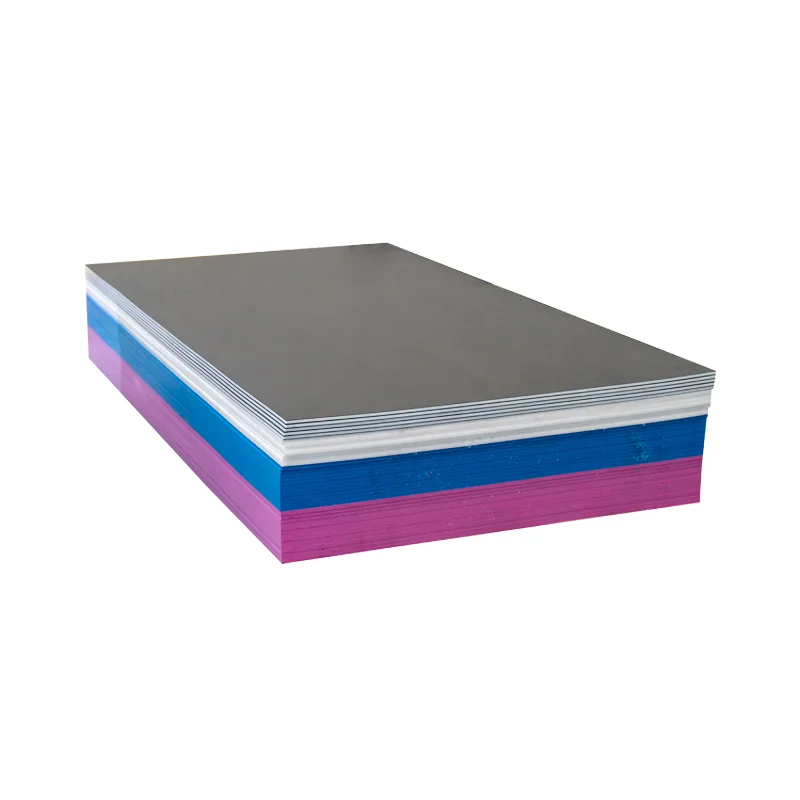
How two-color engraving sheet works
- The visible cap layer provides the background color.
- A router or engraving tool removes the cap along the artwork path.
- The contrasting core becomes the text or graphic color.
- Cutting, edge finishing, holes and mounting complete the sign or label.
Engraving depth must be sufficient to expose the core consistently but should not remove unnecessary material. Ask for the cap-layer specification for the selected product and run a machining trial when the artwork has fine lines, small text or large filled areas.
Application and specification table
| Application | Important sheet features | Buyer checks |
|---|---|---|
| Equipment nameplate | Fine contrast, flatness and clean edges | Minimum text size, hole positions, chemicals and cleaning |
| Valve, cable or asset tag | Readable core color and durable attachment | Tag size, hole/slot, abrasion and numbering sequence |
| Safety or instruction sign | Strong color contrast and repeatable artwork | Applicable sign standard, viewing distance, symbols and mounting |
| Directional or room sign | Appearance, surface finish and color consistency | Typography, edge finish, indoor/outdoor use and fixing |
| Outdoor facility label | Suitable UV-stabilized grade | Climate, exposure duration, thermal movement and fasteners |
| Control or legend panel | Accurate holes, cutouts and engraved legends | Datum, tolerance, component fit and drawing revision |
The sheet is only the substrate. The buyer or sign designer remains responsible for regulatory text, hazard symbols, color rules, character size, placement and other requirements that apply at the destination.
Color pair and surface selection
Specify colors as surface/core, for example black/white or red/white. Also state which face will be engraved and whether both faces need a cap layer. A photograph or monitor image is not a reliable color standard; use an agreed physical sample or color reference and define the acceptable variation for repeat orders.
Matte, smooth and textured finishes behave differently under lighting and processing. A matte face can reduce glare, while a texture may limit very fine engraving. Protective film can reduce transit scratches, but the film type and whether it covers one or both faces should be confirmed.
CNC routing and engraving details
| Process item | Why it matters |
|---|---|
| Tool geometry and condition | Affect edge sharpness, burrs and fine-detail quality |
| Depth control | Must reveal the core across the full artwork without excessive cutting |
| Feed, speed and chip removal | Affect heat buildup, melting, chips and surface finish |
| Sheet flatness and hold-down | Help keep engraving depth consistent across larger panels |
| Minimum line/text size | Must suit the cap layer, cutter and viewing requirement |
| Entry/exit and corner radii | Affect the appearance of small characters and sharp internal corners |
CNC routing is a common process for this material. Laser processing should be trialed and approved for the exact sheet and equipment because polyethylene can melt or distort and the process requires appropriate extraction and safety controls. Do not assume settings from acrylic or another engraving plastic will transfer directly.
Artwork and drawing requirements
- Vector artwork for logos, text and symbols
- Finished sign or tag dimensions and thickness
- Surface/core color pair and engraving face
- Minimum character/line size and required depth
- Hole, slot and cutout dimensions from defined datums
- Corner radius, edge finish and mounting detail
- Part numbering or variable-data list
- Drawing number, revision, quantity and quantity per design
Convert fonts to outlines or provide the approved font file, and identify the artwork scale and units. For safety signage, supply an approved proof rather than asking the factory to infer the wording or symbol layout.
Outdoor use and mounting
Outdoor suitability depends on the exact UV-stabilized formulation, color, climate, exposure and expected service life. Standard HDPE or a dark color alone does not prove long-term weathering performance. Request information for the ordered grade.
HDPE expands more than metal. Longer signs need fastening details that allow thermal movement without excessive clamping or buckling. Specify holes or slots, fastener/washer size, backing support, edge distance and whether the sign is mounted flat or freestanding. For broader outdoor guidance, see HDPE sheets for marine and outdoor applications.
Pre-production and inspection checks
- Approve the color pair and face before production.
- Use a sample or first article for small text, fine graphics or new tooling.
- Check engraving contrast, missing cap areas, burrs and surface scratches.
- Measure overall dimensions and critical hole/cutout positions.
- Verify text, numbering and orientation against the approved proof.
- Confirm protective film, labels and packing sequence.
For repeat orders, reference the same approved artwork and drawing revision. If the sheet construction, color standard or cap specification changes, reapprove the sample instead of relying on the previous order name alone.
RFQ checklist for two-color HDPE engraving board
| Sheet | Surface/core color, total thickness, size, finish and UV requirement |
|---|---|
| Artwork | Vector/PDF proof, fonts/outlines, revision and variable-data list |
| Engraving | Face, depth, minimum line/text size and process |
| Fabrication | Cut profile, holes, slots, corner radius, edges and tolerances |
| Quantity | Sheets or finished parts, quantity per design and repeat forecast |
| Inspection | Color sample, first article, critical dimensions and proof check |
| Delivery | Destination, Incoterm, protective film, labels and packing |
Zhihong Plastic supplies two-color HDPE sheets and drawing-based cutting or CNC processing subject to specification review. Color combinations, thickness, sheet size, tolerance and minimum order are confirmed in the quotation.
Frequently asked questions
What engraving depth should we use?
It depends on the actual cap layer, sheet flatness, cutter and artwork. Obtain the cap specification and confirm the result with a machining trial.
Can you match any custom color?
Custom matching may be possible subject to material, quantity and tolerance. Send a physical reference or agreed color code and request a sample confirmation.
Can you supply finished numbered tags?
This can be reviewed from the approved artwork, numbering list, tag drawing, quantity and inspection requirements.
Request an engraving-sheet quotation: send the color pair, thickness, artwork, quantity, process and destination.