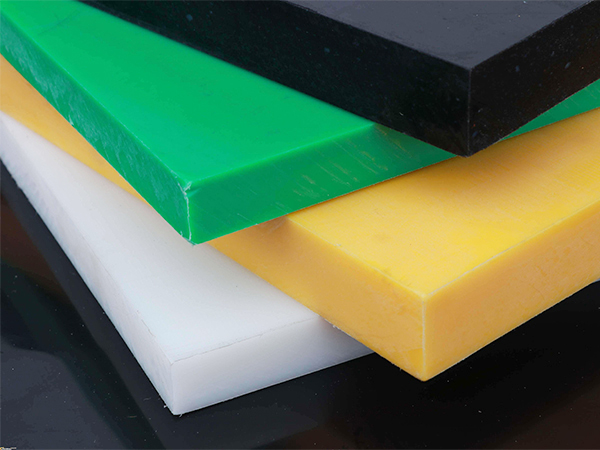
Polyethylene liner boards provide a replaceable contact surface inside chutes, hoppers, bins and other material-handling equipment. Depending on the grade, they can combine low sliding friction, abrasion resistance and impact toughness. The liner protects or changes the behavior of the contact surface; the equipment behind it still provides the structural support.
The handled material, PE grade, panel layout and mounting all affect performance. The practical limits include thermal movement, deformation under sustained load, hot-service conditions and wear at impact points. Material selection and panel design therefore need to be considered together.
What a polyethylene liner does
A liner may start as a full sheet and be cut or machined into panels that fit the backing surface. In service, its material properties and installation work together: poorly supported panels, exposed edges or unsuitable joints can fail even when the polymer has good wear resistance.
- Wear protection: a replaceable panel separates the handled material from the underlying equipment surface. Abrasion resistance matters where particles repeatedly rub or cut against it.
- Flow assistance: a low-friction surface can reduce resistance to sliding and material buildup. Moisture, cohesion and equipment geometry still influence whether the load moves freely.
- Support and safety: a liner is not automatically a load-bearing wall, containment barrier or safety guard. Those functions depend on the complete equipment design.
Start with the material being handled
Sharp particles sliding along a chute produce a different wear pattern from large pieces striking a transfer point. Record particle size and shape, incoming direction, speed, drop height and where wear is concentrated. Also note changes between dry and wet loads, because moisture can change adhesion and flow.
- For bulk solids, distinguish fine powder, rounded granules and sharp coarse pieces. Identify corners or transitions where material collects and the areas most exposed to impact.
- For wet or process equipment, identify the liquid or slurry, concentration, operating and cleaning temperatures, and contact duration. Low water absorption does not establish resistance to every chemical.
- For outdoor equipment, consider sunlight, rain, drainage and temperature changes. Exposed panels need a suitable formulation as well as room for thermal movement.
HDPE, HMWPE and UHMWPE are different liner choices
HDPE, HMWPE and UHMWPE are not interchangeable liner specifications. Longer polymer chains in UHMWPE contribute to its wear and impact behavior, but do not automatically make it a stiffer panel. Choose the grade and formulation for the duty, not by color or a general PE label. Compare our PE sheet and roll options and HDPE sheets by material and fabrication requirements. The UHMWPE application guide describes wear and sliding uses.
Match the liner to the main failure mode
| Service condition | Details that matter | Effect on liner selection |
|---|---|---|
| Impact and abrasion | Particle shape and size, drop height, flow path, contact speed and local wear | Impact toughness and abrasion resistance address different damage mechanisms |
| Support and load | Backing surface, unsupported spans, fastening, load duration and allowed deflection | Panel bending and long-term deformation depend on geometry, temperature and support |
| Liquid and cleaning exposure | Medium, concentration, temperature, exposure time, cleaning cycle and mechanical stress | Check chemical compatibility for the actual grade and combined conditions |
| Fabrication and fit | Drawing revision, finished dimensions, holes, edges, joints and inspection points | Machined-panel tolerances and installation clearances are different requirements |
The table separates contact wear, panel deformation, chemical exposure and fit. A single property chart cannot resolve all of them. In a replacement project, inspect the old liner and backing surface first: the damage location often reveals more about the duty than a general comparison of plastics.
Grade and formulation matter more than color
Record the material designation, formulation, virgin or recycled-material requirement, thickness, dimensions and surface. Compare test data using the same method and relevant specimen conditions. A wear-test result from one grade or test setup is not a prediction of service life for every liner made from PE.
Special formulations can address sliding friction, UV resistance, electrical conductivity or flame behavior. These are distinct requirements, not standard features of every liner board. Food-contact use also needs documentation for the specific grade and intended conditions; color alone does not establish it.
Different zones need different liner details
Impact and transfer zones
At a transfer point, consider how the falling material reaches the panel and how the backing carries the impact. Thickness, support and fastener placement need to work together. Protect exposed edges and plan replaceable sections where wear is concentrated; adding thickness alone may not resolve a weak mounting arrangement.
Sliding and flow zones
Here the aim is to limit resistance at the contact surface while controlling wear. Hopper geometry, wall friction and the handled material's tendency to stick or compact all affect discharge. Compare performance with the actual material, including its moisture condition; a low-friction liner does not by itself prevent bridging or buildup.
Panel joints and replacement access
Lay out joints and panel edges with the flow direction in mind so they do not create unnecessary obstructions or let material collect behind the liner. Include transitions, drainage where needed and access to inspect fasteners. The replacement plan should allow a worn section to be removed without rebuilding the entire lining.
Thermal movement and mechanical fastening
Polyethylene expands and contracts with temperature. If a long panel is tightly restrained against a backing with different thermal movement, stresses can make it bow or bulge. Account for panel length, operating temperature, hole or slot clearance and the chosen fastening system. Clearance must allow the intended movement without compromising retention or leaving vulnerable edges.
HDPE and conventional UHMWPE do not share the same welding behavior. UHMWPE's high melt viscosity makes standard joining methods more demanding; grade-specific welding systems may be possible. PE's low surface energy also makes adhesive bonding difficult. For a bonded or welded liner, validate the chosen material, joint and process together.
Cutting and machining liner panels
PE panels can be cut and machined for holes, slots and shaped edges. Heat buildup, clamping distortion and residual stress can affect the finished dimensions, so functional tolerances should reflect the material and part geometry. Distinguish the nominal sheet thickness from the required dimensions and fit of the finished panel. Use the custom HDPE and PP fabrication guide to specify drawings, tolerances and inspection points.
Temperature, chemicals and exposed service
Service-temperature guidance must be read with the grade, load and exposure time; a polymer's melting point is not its working limit. Under sustained load, PE can deform gradually through creep, especially as temperature rises. Outdoor service may need UV stabilization. Neither black color nor the polyethylene name establishes a particular weathering, fire or antistatic classification.
For process equipment, assess the medium, concentration, temperature, contact time and mechanical stress together. Cleaning conditions may be more demanding than normal operation. A chemically compatible panel still needs suitable fasteners, joints and backing; a loose wear lining is not automatically a sealed containment system. Review the HDPE and PP chemical-processing guide for compatibility and fabrication considerations.
Inspection, handling and traceability
- Check thickness, panel dimensions, hole positions, edges and surface condition against the agreed drawing. Check joint fit and fastening clearances separately from stock-sheet tolerances.
- Link grade and lot identification to any requested material declaration or test record. A sample or first panel can help check fit, but does not demonstrate long-term wear performance.
- Support panels on a flat, sufficiently sized pallet and protect finished surfaces and edges. Packing, labels and the panel installation order should make handling and identification straightforward.
Information that makes a liner request useful
- Equipment and handled material: include the liner's function, flow direction, particle size and moisture condition.
- Material and panel layout: identify the PE grade if specified, thickness, dimensions, surface, joints and replaceable sections.
- Operating conditions: identify impact zones, support, load duration, temperature, chemical exposure and cleaning method.
- Supply scope: include drawings, cutting or machining details, quantity, inspection needs, packing and delivery destination.
Frequently asked questions
Are all polyethylene liner boards UHMWPE?
No. PE is a family of materials, and liner boards may use HDPE, HMWPE, UHMWPE or a modified formulation. UHMWPE is often considered for demanding wear and sliding duties, but its toughness does not make it the stiffest option. Confirm the exact grade rather than relying on the board name.
Can a material data sheet establish liner performance?
A data sheet helps compare the material's measured properties. It does not describe the entire installation or predict wear life without the contact conditions. Panel support, joints, thermal movement and impact need to be assessed alongside the material. Where flow or wear is uncertain, a trial under representative conditions can be more useful than a generic ranking.
What changes when a steel liner is replaced with PE?
PE has lower density than steel and different stiffness, thermal movement and fastening needs. Retain or redesign the backing as required, and check impact zones, unsupported spans, operating temperature and wear. Good sliding behavior can be useful, but does not make PE a direct structural or hot-service replacement for steel.
Discuss a polyethylene liner board order
Send us the handled material, operating conditions, panel drawing or dimensions, quantity and delivery destination. Tell us whether you need full sheets, cut panels or machined features so we can review the material, fabrication scope and delivery details together. Request a polyethylene liner-board quotation.