A temporary access route should protect the surface while accommodating the traffic planned for the site. Polyethylene ground protection mats are used for construction access, utility maintenance, landscaping and outdoor events. Selection starts with the ground and the way vehicles or people will use the route, not simply a claim that a mat is heavy-duty.
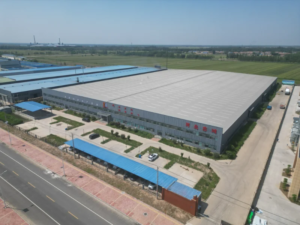
We manufacture ground protection mats and temporary road panels. This guide explains the traffic, material and installation details to consider when choosing panels for your project.
Plan the route around its users
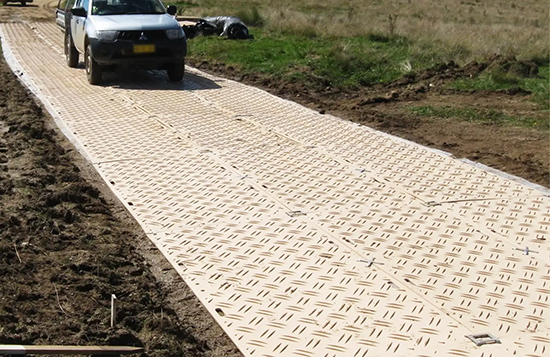
A landscaping route across a lawn, a utility access route through a field and a construction delivery route have different requirements. Consider what needs protection, how long the route will remain in place and whether it will be moved between jobs. Protecting a finished surface does not mean that the ground beneath it can support every vehicle.
For events, separate pedestrian walkways from vehicle access where practicable. Walking routes need attention to edges, gaps and surface condition; vehicle routes also need enough width for the intended movement and turning space. Plan entry and exit points rather than choosing panels from the straight section alone.
Match the mats to traffic and ground conditions
Vehicle gross weight is only a starting point. Wheel or track contact, repeated passes, turning and braking affect how the mats and supporting ground are loaded. Prepare the following information before comparing systems:
- Vehicle or equipment type, gross weight, available wheel or axle loads, and whether it uses tyres, rubber tracks or steel tracks.
- Ground type and bearing condition, drainage, soft spots, uneven areas and known underground services or voids.
- Route length and width, entry points, slopes, turning areas and locations where vehicles stop or brake.
- Number of movements, period of use and likely changes in weather or ground condition.
Mats may spread contact loads, but they do not make unsuitable ground adequate. Ground preparation or a different access system may be needed. Do not use ordinary ground protection mats to bridge trenches, holes or unsupported gaps.
Crane outriggers, stabilisers and engineered working platforms are separate support applications. An access mat is not automatically an outrigger pad because it is made from HDPE or UHMWPE. These applications require a specifically suitable support arrangement and ground assessment that meet the equipment requirements.
Compare access surfaces by the whole job
Polyethylene, plywood, steel and concrete can serve different access needs. Compare the specified product and installation, not just the material name. The table below highlights practical differences; it is not a load-rating comparison.
| Access surface | Typical features | Site and handling checks |
|---|---|---|
| Polyethylene mats | Low water absorption; reusable when condition permits | Match grade, panel design, connections and ground support to the traffic |
| Plywood panels | Can be cut to the required shape; performance depends on grade | Check moisture exposure, damage, support and suitability for repeated use |
| Steel plates | Rigid plates with substantial handling weight | Plan lifting, edge transitions, traction and supporting ground |
| Concrete panels | Rigid panels requiring planned transport and positioning | Check panel specification, base preparation and removal arrangements |
For routes moved between projects, include transport, lifting, installation, cleaning and replacement in the cost comparison. A panel that costs less to buy is not necessarily less expensive over several jobs, and reusability depends on its condition after each use.
HDPE and UHMWPE: material properties are not mat ratings
HDPE means high-density polyethylene; UHMWPE means ultra-high-molecular-weight polyethylene. They are distinct polyethylene materials, not interchangeable names for a finished mat.
Polyethylene generally has low water absorption and useful toughness. UHMWPE is known for its wear resistance, but material properties vary with grade and processing. Our guide to UHMWPE material properties and applications provides related material context.
| PE mat material | General material tendencies | Finished-mat requirements |
|---|---|---|
| HDPE | Low water absorption and useful toughness; grade-dependent performance | Confirm panel geometry, surface, connections and intended traffic |
| UHMWPE | Wear resistance and impact behaviour depend on grade and conditions | Do not infer vehicle or outrigger capacity from the polymer name |
Specify the offered material grade and mat construction in the order. A resin or sheet datasheet does not establish the load capacity, traction or service life of a finished access system. If you need a particular rating or test result, identify the intended conditions and ask what evidence applies to the exact product.
Check surface texture, connections and handling
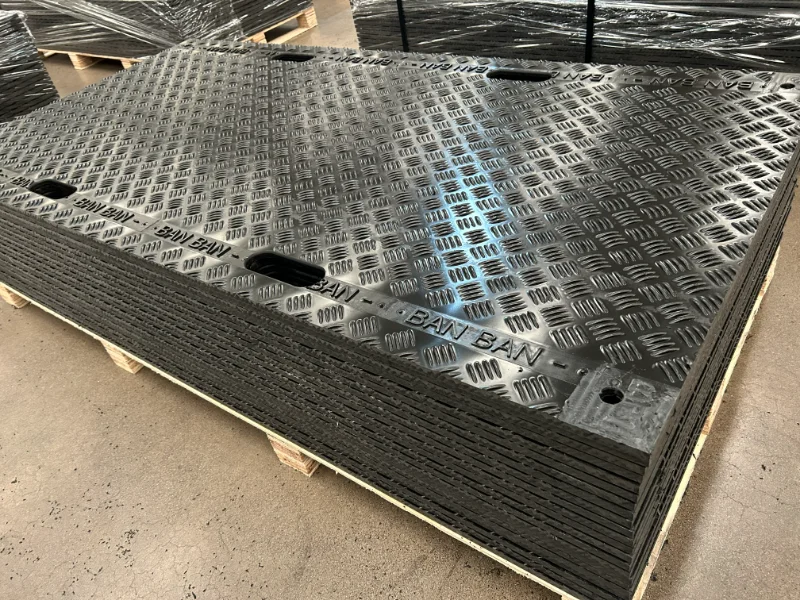
A textured surface can help provide grip, but a diamond or chevron pattern is not proof of slip resistance in every condition. Mud, ice, contamination, tyre condition, slope and drainage all affect traction. Choose the surface for the intended users and keep it clean during use.
Tell us whether the route will carry tyres, rubber tracks or steel tracks. Tracked traffic and sharp turning can affect the mat surface and connections differently from straight vehicle passage. Compatibility must be checked for the specified product; do not assume that all polyethylene mats accept every track type.
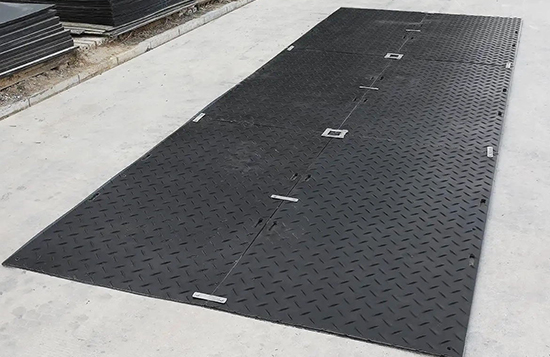
Connections should suit the panel layout and expected movement. Confirm the connector type, hole positions and mating details, including how panels join at turns or transitions. Adding holes alone does not establish a suitable connected system.
Check individual panel weight, handling features and the equipment needed to lift and position the mats. Do not assume a panel can be handled manually from its material or dimensions alone.
Install, inspect and prepare for reuse
Installation starts with the site plan and the product instructions. Check ground support and drainage, remove sharp debris and address uneven or unstable areas before laying the mats. Preparation is particularly important where traffic repeats, vehicles turn or rain changes the ground condition.
- Lay panels to the planned route and check that their support and edge transitions match the intended use.
- Fit the specified connections and check that panels remain secured during operation.
- Inspect position, settlement, edges and connectors before use and after rain or repeated traffic.
- Stop using damaged or displaced sections until their condition and supporting ground have been assessed.
- Clean the mats, inspect surface wear and connection points, and follow the product handling and storage instructions before reuse.
Our HDPE road mat installation guide covers related planning and handling considerations. Site-specific assessment and the instructions for the supplied mats take priority over a general guide.
Send the project details for a quotation
For a factory quotation, send the traffic and site information above together with the required mat dimensions, quantity, surface finish, colour and connection details. Include drawings or a route layout if available, plus the delivery destination and any packing or marking requirements.
We will confirm the available material and panel configuration, production scope, packing and delivery terms for the enquiry. Product supply confirmation is separate from approval of the ground or an engineered support arrangement.